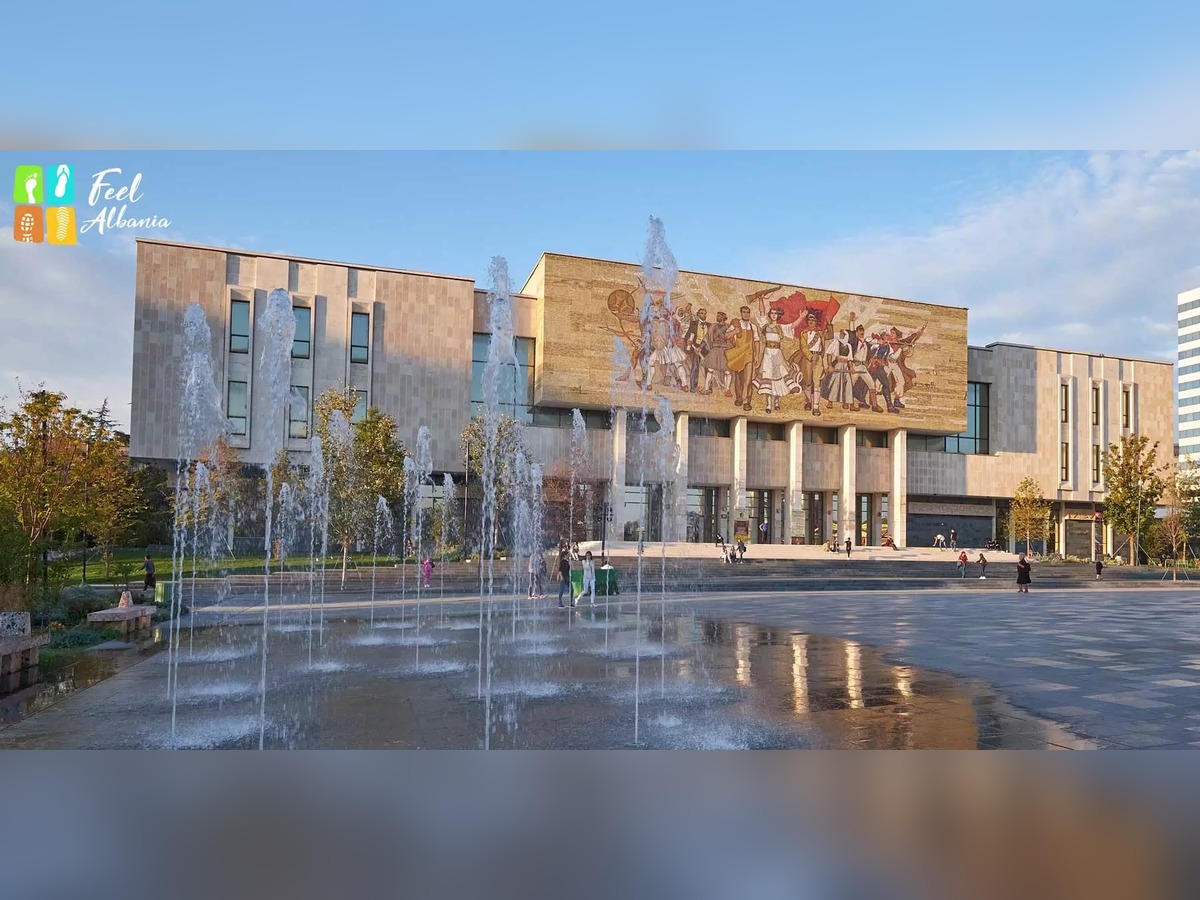
Tirana’s National History Museum, opened in 1981 during Albania’s communist era, is more than a building—it is a visual and physical chronicle of a nation’s resilience. Spanning 27,000 square metres, the museum’s collections trace Albania’s journey from prehistoric cave dwellers to the fall of communism, with each pavilion offering a distinct chapter.
The museum’s most striking feature is its **façade mosaic, The Albanians—a 40-metre-long, 11-metre-high masterpiece created by five Albanian artists. Completed in 1980, it depicts 13 iconic figures representing Albania’s history: an Illyrian warrior, a medieval knight, Skanderbeg (the 15th-century hero who defied the Ottomans), and even communist partisans. After Albania’s democratic transition in the 1990s, some communist symbols (like the golden stars) were removed, but the mosaic remains a powerful symbol of national pride.
Inside, the Pavilion of Antiquity houses 585 artifacts, including the ‘Beauty of Durrës’—a 4th-century BC marble statue of an Illyrian woman—and coins from the Illyrian kingdom, proof of a once-thriving economy. The Middle Ages Pavilion features the Epitaph of Gllavenica (1373), a rare medieval inscription, while the Independence Pavilion displays the original 1912 Declaration of Independence and Skanderbeg’s sword.
One of the museum’s most controversial sections is the Communist Terror Pavilion, opened in 2012. Here, visitors confront Albania’s darkest chapter: the one-party regime (1945–1990), which imprisoned, exiled, or executed thousands. Exhibits include prison records, photographs of political prisoners, and personal letters—raw reminders of a system that sought to erase dissent.
The museum also honours Mother Teresa, Albania’s most famous global citizen. Born in Skopje (then Ottoman Empire), she spent her early years in Albania before becoming a nun in Ireland. A dedicated pavilion showcases her religious artifacts, letters, and Nobel Prize, reflecting her enduring legacy.
Currently closed for renovation until 2028, the museum remains a landmark on Skanderbeg Square. When it reopens, it will stand as Albania’s definitive storyteller—one where every artifact, from a Neolithic axe to a communist-era typewriter, carries the weight of a nation’s past.