

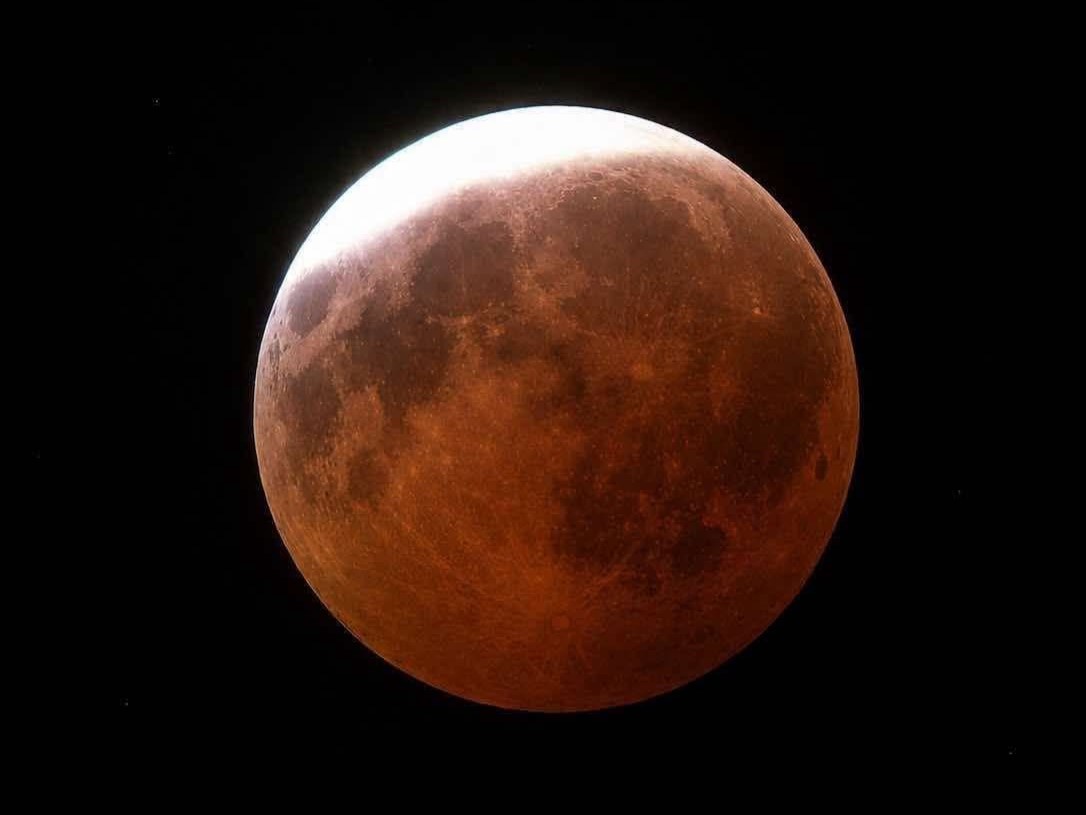
Partial Lunar Eclipse Peaks Over Trinidad And Tobago As Earth’s Shadow Covers Nearly Entire Moon
Skywatchers across Trinidad and Tobago were treated to a dramatic celestial display early Friday morning as a deep partial lunar eclipse reached its maximum, leaving almost the entire Moon covered by Earth’s shadow.
The eclipse peaked at approximately 12:12 a.m. on Friday, August 28, 2026, with the Moon positioned high in the southern sky over Trinidad and Tobago.
At maximum eclipse, approximately 96.2 per cent of the Moon’s surface was covered by Earth’s dark umbral shadow, leaving only a narrow portion directly illuminated by the Sun. The unusually deep partial eclipse gave much of the Moon a reddish or copper-coloured appearance, resembling what is commonly called a “blood moon.”
However, the event was not technically a total lunar eclipse because a small portion of the Moon remained outside Earth’s umbra.
The celestial event began at approximately 9:23 p.m. on Thursday, August 27, when the Moon first entered Earth’s lighter penumbral shadow. The more noticeable partial phase began around 10:33 p.m., as the darker umbral shadow started moving across the lunar surface.
Maximum eclipse occurred at approximately 12:12 a.m., when the Moon was nearly 70 degrees above the horizon from Port of Spain, providing Trinidad and Tobago with a favourable position to observe the event.
The spectacle was not over immediately after the peak. The Moon continued moving through Earth’s shadow, with the partial phase expected to end at approximately 1:51 a.m. and the final penumbral phase around 3:01 a.m.
From beginning to end, the eclipse lasts approximately five hours and 38 minutes, while the visually prominent partial phase lasts about three hours and 18 minutes.
A lunar eclipse occurs when the Earth moves between the Sun and the Moon, causing Earth’s shadow to fall across the lunar surface. Unlike a solar eclipse, no protective eyewear is required to safely observe a lunar eclipse.
The August 28 event is particularly striking because of how close it comes to totality, giving residents across Trinidad and Tobago and other parts of the Americas an opportunity to witness an almost completely eclipsed Moon.
### Anchor Script
Skywatchers across Trinidad and Tobago witnessed a spectacular sight early Friday morning as a partial lunar eclipse reached its peak shortly after midnight.
At approximately 12:12 a.m., nearly the entire Moon was covered by Earth’s dark shadow, with about 96 per cent of its surface affected.
The deep eclipse left only a narrow portion of the Moon brightly illuminated, while much of the remaining surface could take on reddish and copper tones.
Although its appearance may resemble a blood moon, this is officially a partial lunar eclipse because the Moon never becomes completely covered by Earth’s umbral shadow.
The eclipse began shortly after 9:20 Thursday night, with the more dramatic partial phase starting around 10:33 p.m.
The Moon remains in the eclipse after its midnight peak, with the partial phase ending around 1:51 Friday morning and the entire event concluding shortly after 3 a.m.
The eclipse is safe to view with the naked eye and can also be observed using binoculars or a telescope.