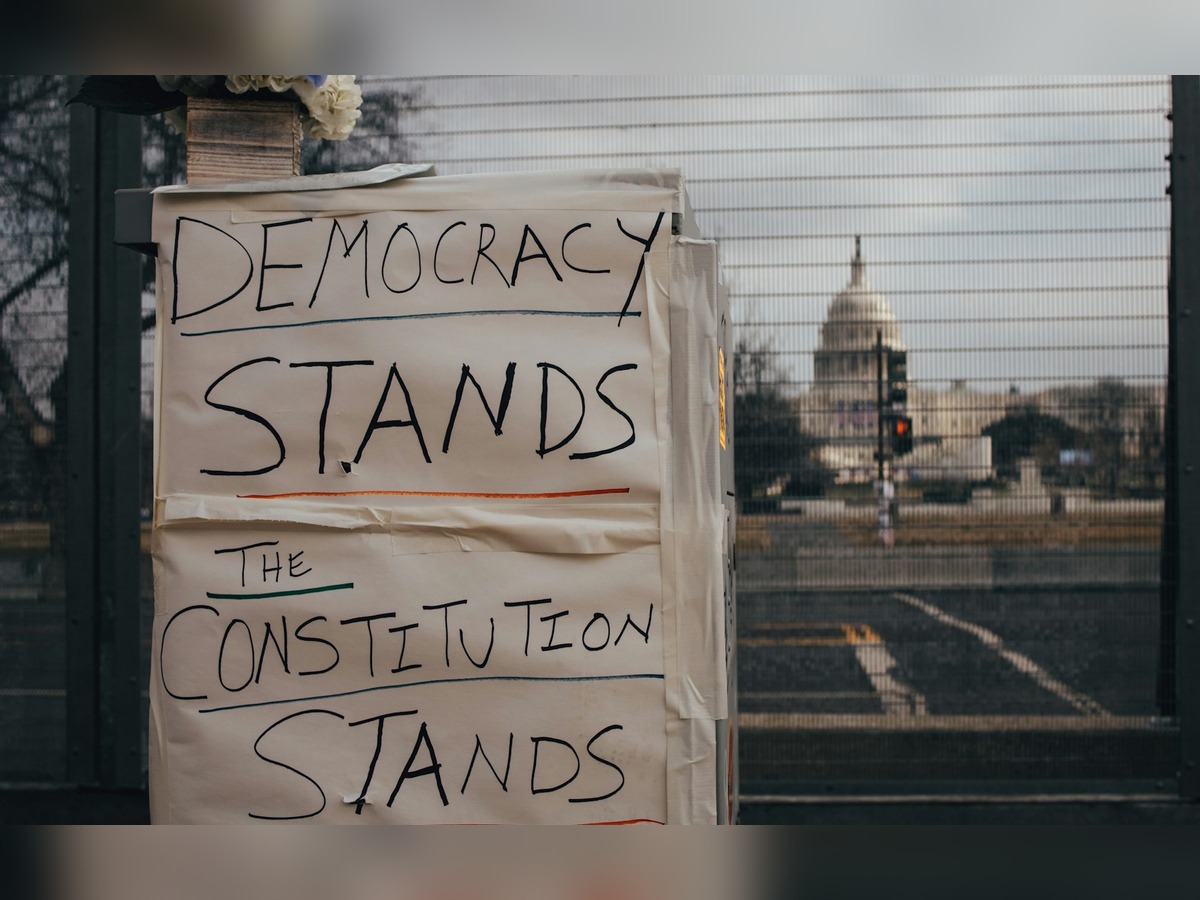
American democracy depends on more than its Constitution, elections and courts. In a newly published analysis, Keith Magee argues that the country also needs a strong moral culture to sustain the institutions and democratic norms on which its political system relies.
Writing for the London School of Economics and Political Science’s United States Politics and Policy blog, Magee examines the relationship between constitutional government and the ethical responsibilities of the people who lead and participate in it. His central argument is that democratic institutions cannot, on their own, ensure the values and conduct necessary for a functioning democratic society.
Magee’s reflection followed his attendance at a September 29 event at the London School of Economics titled “A Theory of Constitutional Failure: The American Case.” The discussion, featuring constitutional scholars Jack Rakove and Larry Kramer, considered whether the United States was experiencing a constitutional crisis or had reached a more serious point of constitutional failure.
The experience prompted Magee to consider a related question: what happens when democratic institutions remain in place but the moral culture needed to support them begins to weaken? Democracy beyond constitutional rules
Constitutions establish the structure of government, protect rights and create mechanisms for accountability. Elections provide a means of choosing representatives, while courts help interpret and enforce the law. Magee argues, however, that these arrangements cannot independently teach people to be truthful, accept defeat graciously or recognise the humanity of those whose political or religious beliefs differ from their own.
He describes democracy as both an institutional arrangement and a moral undertaking. In this view, preserving democratic government requires citizens and leaders to consider obligations that extend beyond personal interests and political victories.
The distinction is particularly important in leadership, Magee argues. Conduct that is legally permitted is not necessarily morally justified. Ethical leadership therefore requires accountability, honesty even when inconvenient and a willingness to put the common good ahead of the pursuit of power. Lessons from different traditions
Magee places these ideas in a broader historical context, arguing that moral limits on authority and responsibilities to the wider community are not exclusive to Western political thought or a single religious tradition.
He points to the Edicts of Ashoka, issued in the third century BCE across the Mauryan Empire, as an example of a historical vision of governance associated with religious tolerance, dialogue and humane treatment of subjects. He also discusses the Great Law of Peace, or Gayanashagowa, associated with the Haudenosaunee Confederacy, which emphasises collective deliberation and responsibilities to future generations.
The Ten Commandments, he adds, offer another historical expression of a community organised around shared obligations. These examples are not presented as direct sources of the US Constitution, but as evidence of a longstanding human effort to connect authority with ethical responsibility.
Magee also examines the American motto “In God We Trust,” which first appeared on US coinage during the Civil War and was formally adopted as the national motto in 1956. He uses it to raise a broader question about what professed commitments to values beyond the individual should mean when people exercise public power. The challenge facing democratic society
Magee’s argument is that legal safeguards and institutional arrangements remain important but cannot substitute for the judgement and character of those who operate them. Democratic resilience, in his account, depends on whether leaders and citizens can recognise responsibilities beyond their own convictions and immediate interests.
His analysis ultimately calls for a wider conversation about the ethical foundations of American public life. The question is not only what the law permits or how power is distributed, but also what those entrusted with power owe to others and to the society they serve.