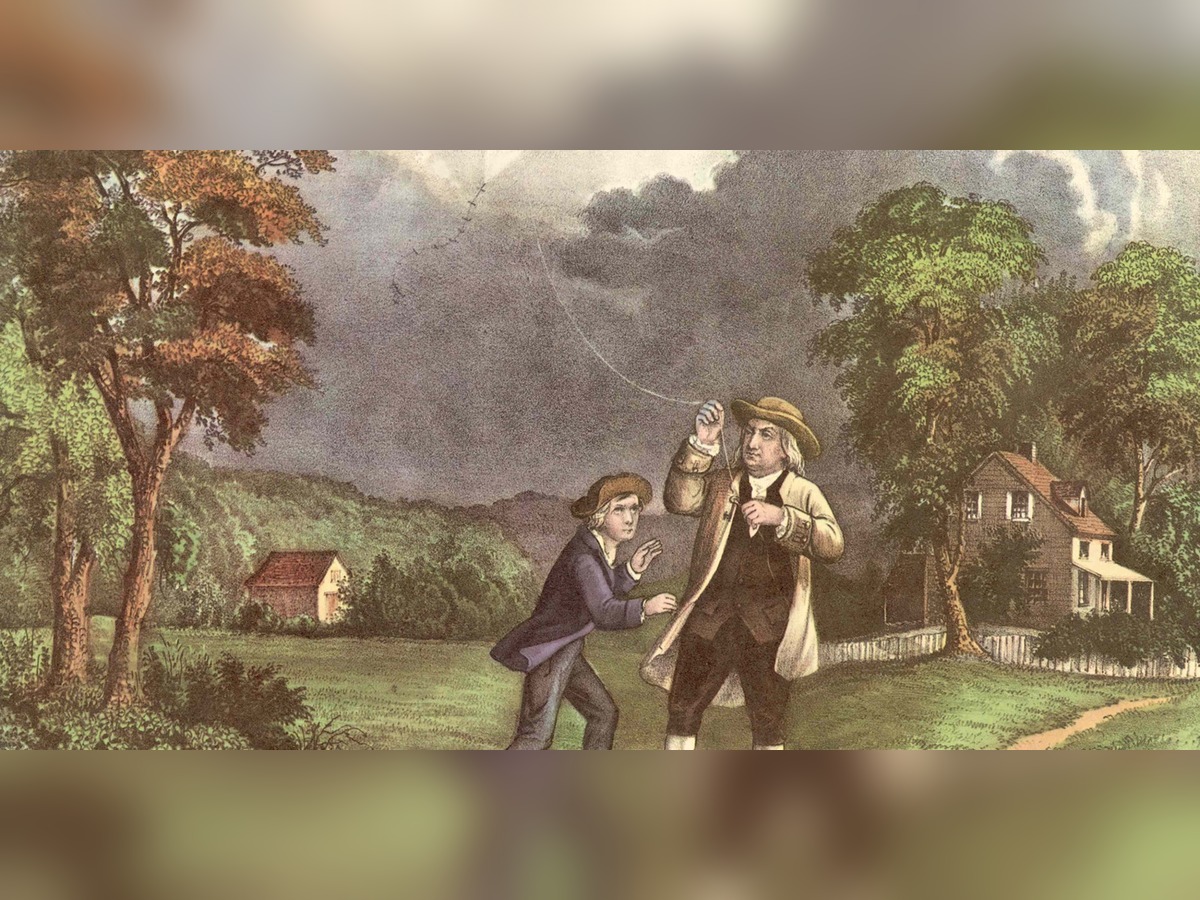
In 1752, Benjamin Franklin’s daring kite experiment during a thunderstorm proved that lightning was electrical—a discovery that laid the foundation for America’s eventual electrification. Tying a metal key to a kite string, Franklin demonstrated that electricity from storm clouds could travel through conductors, a breakthrough that fascinated scientists and inventors for decades. Though Franklin’s experiment was risky (he nearly electrocuted himself), it confirmed his theory that lightning and static electricity were the same force. This insight spurred later inventors, including Thomas Edison, to develop practical applications like the light bulb in 1879. The experiment’s legacy endures in modern power grids, which still rely on the principles Franklin uncovered. Without his work, the electrification of ordinary homes in the late 19th and early 20th centuries might have been delayed by generations.
Franklin’s experiment wasn’t just scientific curiosity—it was a turning point. Before 1752, electricity was a mysterious phenomenon observed in labs, but Franklin’s demonstration showed it could be harnessed. His findings were published in Poor Richard’s Almanack and European journals, sparking global interest. By the 1880s, American cities like New York and Boston began wiring homes for power, thanks in part to the infrastructure built on Franklin’s discoveries. Even today, safety standards for electrical systems reflect his warnings about grounding and insulation.
The experiment’s risks are often overlooked. Franklin later admitted he was ‘extremely lucky’ not to be killed, as the wet string and key could have conducted a fatal shock. Yet his willingness to take that risk embodied the Enlightenment’s spirit of empirical inquiry. The kite itself is lost to history, but replicas and illustrations (like the one from The Pennsylvania Gazette, 1752) keep the story alive. Franklin’s work proved that electricity wasn’t just a lab curiosity—it was a force that could power the future.