
Queen’s Park Savannah is today inseparable from the identity of Port of Spain. It is where thousands exercise, families gather, vendors make their living and some of Trinidad and Tobago’s biggest cultural events unfold. But more than two centuries ago, the famous open space had a very different purpose.
The history of the Savannah stretches back to the late 18th century and the arrival of the Peschier family, French-Swiss settlers who came to Trinidad following the 1783 Cedula of Population. The family received approximately 232 acres north of Port of Spain and established a sugar estate on the property. Historical accounts indicate that the estate included sugar fields, a mill, boiling house, the family residence and accommodations for enslaved Africans who worked there.
From Private Estate to Public Land
The decisive change came under Governor Sir Ralph Woodford.
In 1817, the colonial Cabildo purchased the property from the Peschier family for £6,000. Records held by the National Archives of Trinidad and Tobago show that the deed of conveyance was executed on August 18, 1817, with payment arranged in three instalments of £2,000.
One small but fascinating section was excluded from the transaction: the Peschier family’s burial ground.
That cemetery survived the transformation of the surrounding estate and remains within the Savannah today, providing a physical connection to the land’s earlier history.
Before Joggers, There Were Cattle
The Savannah did not immediately become the recreational park Trinidadians would recognise today.
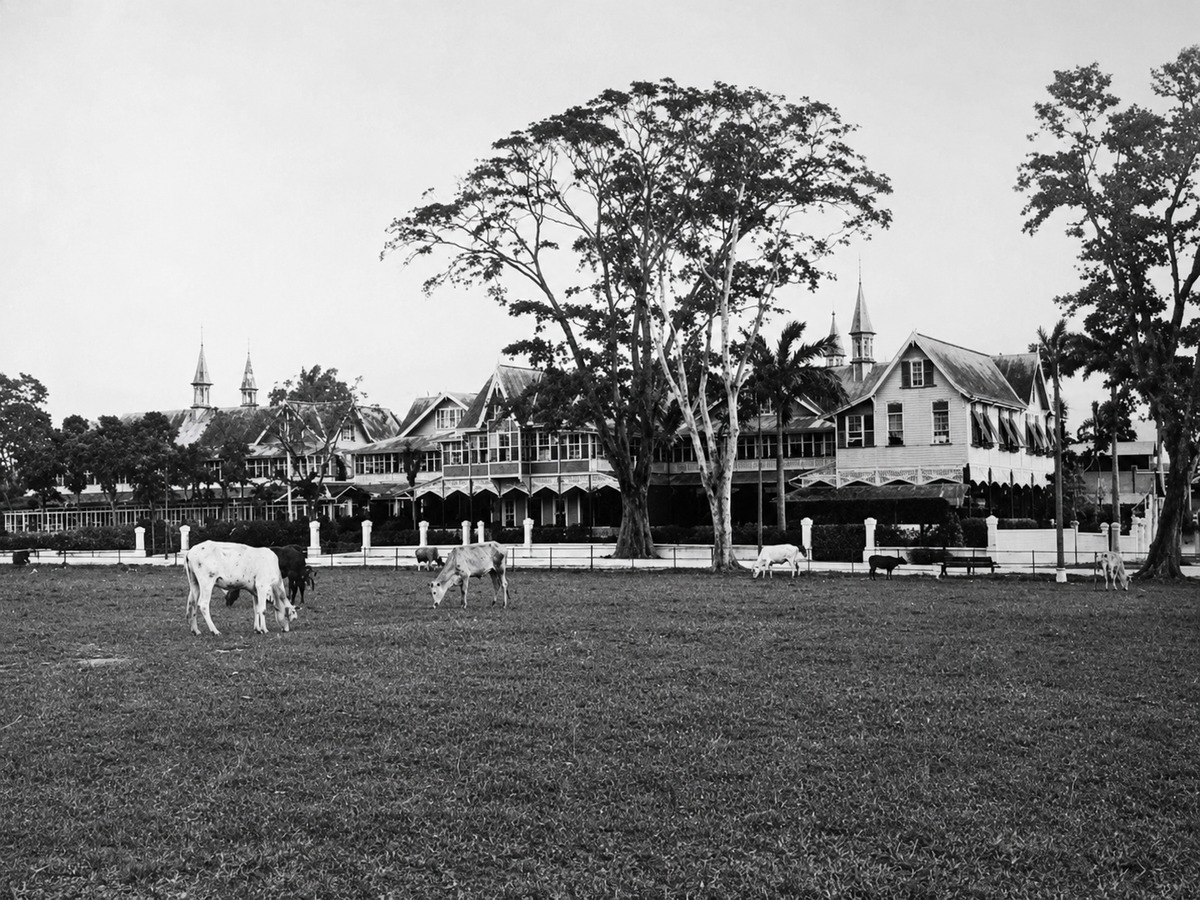
For years after its acquisition, the enormous open area was primarily used to pasture cattle belonging to residents of Port of Spain. It also gradually developed into an open recreational ground.
Horse racing became part of Savannah life early on, with races recorded from at least 1828. A Grand Stand was eventually erected in 1854.
Cricket also became part of its sporting history. The National Archives records that the Savannah hosted local and intercolonial cricket and even served as an early golf course. The last cricket match there was played in 1896 before the club moved to the Oval.
Becoming Queen’s Park
The name also evolved.
Historical material preserved by The University of the West Indies records that the area was officially named Queen’s Park following Queen Victoria’s accession to the throne, with the name associated with 1838 in historical accounts. “Savannah” subsequently became attached to the name popularly, producing the Queen’s Park Savannah known today.
Over the following decades, its role expanded far beyond grazing.
The Savannah became a centre for horse racing, cricket, football and other sporting activities. Remarkably, during the early era of aviation, the open space was even used as an airstrip before Trinidad had established airports.
From Pasture to Carnival Stage
Perhaps no transformation has been more important culturally than the Savannah’s emergence as one of the principal homes of Trinidad and Tobago’s Carnival.
The Grand Stand and surrounding Carnival facilities became synonymous with major competitions and the Parade of the Bands. The National Archives notes that after the 1948 Town Hall fire resulted in the Prince’s Building being used as the temporary Town Hall, the Parade of Bands was held at the Savannah’s Grand Stand.
Today, the Savannah remains associated with major Carnival events, including the Parade of the Bands, Kings and Queens competitions and other national cultural activities.
It sits alongside another important piece of Trinidad’s architectural history: the Magnificent Seven buildings on its western side. Nearby are the Royal Botanic Gardens, Emperor Valley Zoo, the Hollows and several other Port of Spain landmarks.
A Few Savannah Facts
The Queen’s Park Savannah covers approximately 260 acres, or about 110 hectares, making it the largest open green space in Port of Spain. Its perimeter is approximately 3.5 kilometres or 2.2 miles, explaining why generations of Trinidadians have used it for walking, jogging and cycling.
It is also widely described locally as the world’s largest traffic roundabout, although that description is better treated as a popular claim rather than an uncontested international record.
Its history includes sugar production, slavery, cattle grazing, horse racing, cricket, golf, aviation, Carnival, military parades and everyday recreation.
And tucked within all of that history remains the small Peschier cemetery — a surviving reminder that the public Savannah began as private estate land more than two centuries ago.
More Than Just an Open Field
What makes Queen’s Park Savannah remarkable is not simply its size.
Its changing uses trace part of the development of Port of Spain itself: from colonial agricultural land to public pasture, sporting ground, cultural stage and one of the country’s most recognisable communal spaces.
More than 200 years after the Cabildo acquired the property, people still gather on the same land — although instead of sugar cultivation and grazing cattle, the Savannah is now filled with joggers, footballers, Carnival masqueraders, food vendors, families and visitors.
The landscape changed, but its place at the centre of life in Port of Spain only grew stronger.