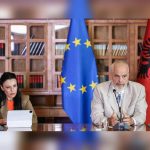

The European Union has formally recognised Albania’s compliance with the criteria for closing Chapter 20 of its accession negotiations, a milestone covering enterprise and industrial policy. In a common position dated October 9, Brussels acknowledged Albania’s alignment with EU policies on small and medium-sized enterprises (SMEs) and the adoption of its Business and Investment Development Strategy, which aims to boost economic competitiveness and attract foreign investment.
The EU’s approval follows Albania’s efforts to reform its business environment, including the adoption of a strategy to support SMEs—critical for Albania’s economy, where small businesses account for over 95% of all enterprises and employ around 60% of the workforce, according to the World Bank. The strategy includes measures to improve access to finance, digitalisation, and regulatory simplification, all of which are seen as essential for Albania’s long-term economic stability.
However, the EU has set strict conditions before fully endorsing the closure. The most immediate demand is the repeal of Albania’s Strategic Investment Law by the end of 2026, replacing it with a unified investment framework fully aligned with EU legislation. The current law, introduced in 2022, has faced criticism for creating an uneven playing field, particularly for foreign investors, by offering preferential treatment to large-scale projects. The EU insists the new law must ensure transparency, non-discrimination, and compliance with public procurement rules, which could significantly impact Albania’s ability to attract high-value foreign direct investment (FDI).
Beyond investment law, Brussels has highlighted three key areas requiring urgent reform: Anti-corruption and institutional strengthening – The EU has repeatedly cited corruption as a major obstacle to Albania’s EU integration. The latest demands include digitising property registration, improving public procurement transparency, and enhancing accountability in public services. Albania’s Corruption Perceptions Index (CPI) score remains low (42 out of 100 in 2023), placing it among the most corrupt in Europe, according to Transparency International. Strengthening these measures is critical not only for EU accession but also for reassuring international investors who have grown wary of bureaucratic delays and irregularities. Sustainable tourism development – Albania’s tourism sector, which contributes over 10% of GDP, has seen rapid growth but also environmental and cultural degradation. The EU has called for better data monitoring, protection of natural and cultural heritage, and community-focused development to prevent over-exploitation. This could lead to stricter regulations on construction in sensitive areas, potentially affecting developers but also preserving Albania’s UNESCO-listed sites like Berat and Gjirokastër. Alignment in critical industries – The EU has specifically mentioned the need for reforms in construction, mining, critical raw materials, defence, and steel production. Albania’s chromite mines—among the largest in Europe—are a particular focus, with Brussels pushing for sustainable extraction practices and compliance with EU environmental standards. Failure to meet these could delay future trade agreements or investment in these sectors.
Despite these demands, the EU has not reopened negotiations on Chapter 20, meaning Albania has met the formal criteria for closure. However, the monitoring phase will be rigorous, with Brussels reserving the right to reopen the chapter if reforms stall. For Albania, this moment is both a celebration of progress and a warning of the challenges ahead—particularly as it races against time to meet the 2026 deadline for repealing the Strategic Investment Law before EU scrutiny intensifies.
The closure of Chapter 20 is a symbolic victory in Albania’s decade-long EU accession journey, but the real test lies in implementation. With negotiations now at Chapter 23 (Judiciary and Fundamental Rights), the coming months will determine whether Albania can balance economic growth, anti-corruption efforts, and EU alignment—all while maintaining investor confidence.