

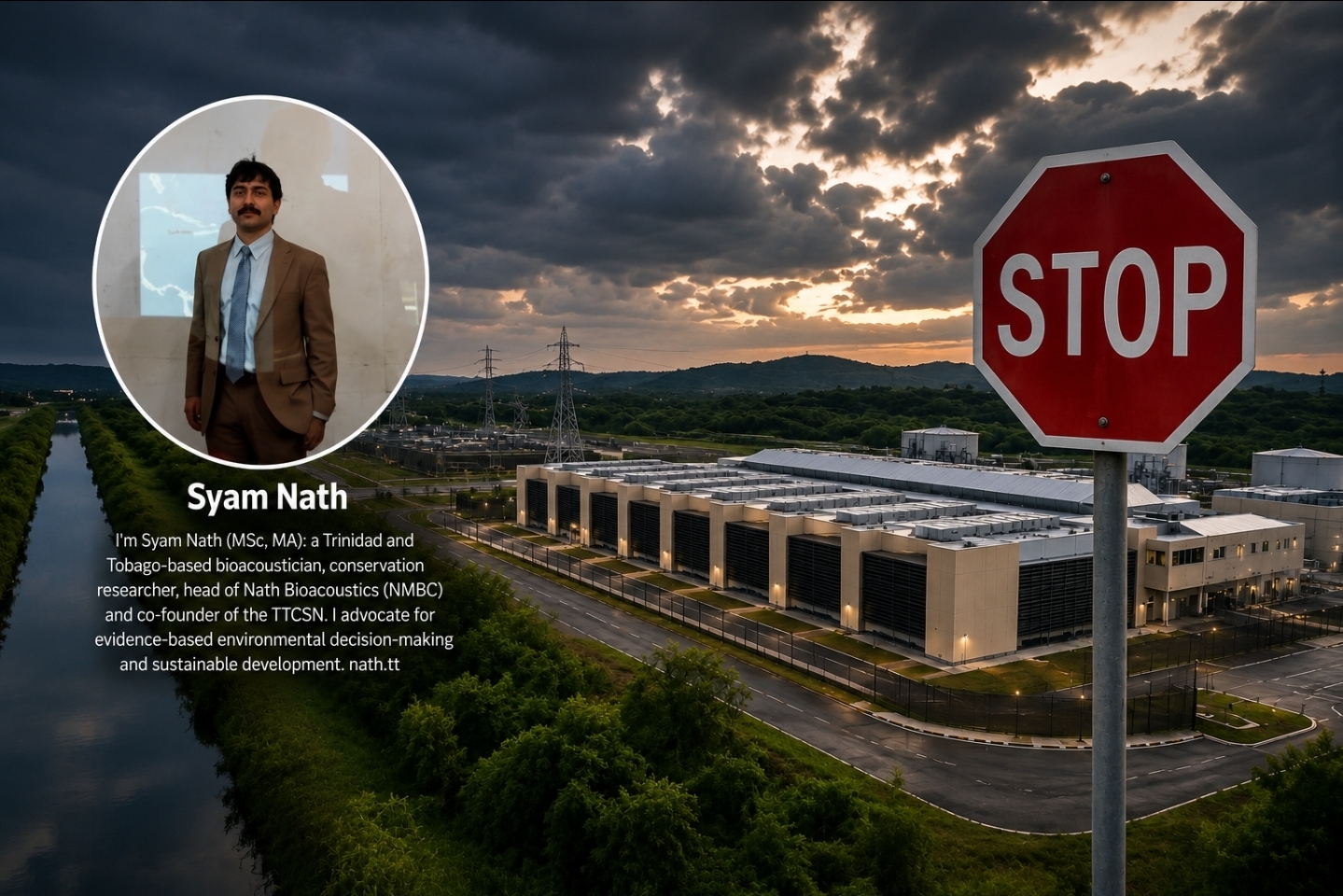
Over 21,000 Sign Petition Demanding Pause on Trinidad’s AI Data Centres
More than 21,000 people have signed an online petition calling on the Government of Trinidad and Tobago to suspend approval of proposed large-scale artificial intelligence data centres until environmental, water, electricity and infrastructure studies are completed and released for public scrutiny.
The Change.org petition, titled “Suspend Approval of AI Data Centres in Trinidad and Tobago,” was created on July 12, 2026, by Trinidad and Tobago-based bioacoustician and conservation researcher Syam Nath.
By Sunday, July 19, the campaign had attracted more than 21,900 verified signatures, with hundreds of people continuing to add their names daily. Change.org reported that 319 people had signed during the latest 24-hour period shown on the petition page.
The petition is addressed directly to Prime Minister Kamla Persad-Bissessar and asks the Government not to grant final approval for the projects until comprehensive assessments have been completed, independently reviewed and opened to public consultation.
Who Started the Petition?
The campaign was launched by Syam Nath, who identifies himself as the head of Nath Bioacoustics and a co-founder of the Trinidad and Tobago Cetacean Sighting Network.
Nath said his work focuses on conservation research and evidence-based environmental decision-making. The photograph used on the petition shows a bottlenose dolphin affected by infection in the Gulf of Paria, which he presented as an example of the environmental pressures already facing the country’s waters.
The petition does not call for Trinidad and Tobago to reject artificial intelligence, technological development or foreign investment altogether. Instead, it argues that decisions involving projects of this scale must be supported by publicly available scientific and technical information.
Key Names Connected to the Growing Opposition
Change.org does not publicly display a complete, searchable register containing the full names and identities of everyone who signed. The petition page currently shows only the first names of some recent supporters, including Hope, Nicole, Jamila, Laura, Andrew, Monifa, Melissa, Marissa, Keron, Helga, Greg, Simon, Jaden, Dianne, Jane and Patrice. Their identities and occupations cannot be independently confirmed from the information displayed.
Therefore, it would be inaccurate to claim that a specific politician, activist, academic or public personality signed the petition unless that person publicly confirms doing so.
However, several prominent people have raised concerns that closely reflect the issues contained in the petition.
Environmentalist Dr Wayne Kublalsingh has questioned whether Trinidad and Tobago possesses sufficient natural gas and infrastructure to support another major energy-intensive industry. He has argued that the economic case remains unclear and that the country should place greater emphasis on renewable-energy industries, battery production and solar technology.
University of the West Indies economics professor Roger Hosein has taken a more supportive position. He has said that the projects could generate foreign exchange, construction activity and employment, while acknowledging that the agreements remain at an early stage.
These individuals are important voices in the public debate, but neither should be described as a confirmed petition signatory without direct evidence.
What the Government Signed
The controversy followed the signing of memoranda of understanding with United States-based companies for two proposed data-centre developments.
One agreement involves Florida-headquartered Hummingbird AI Holdings LLC and establishes a framework for preliminary cooperation, due diligence and coordination on a proposed 150-megawatt AI infrastructure and data-centre facility.
Reports indicate that the Hummingbird project could eventually expand beyond its initial 150-megawatt capacity, possibly reaching as much as 500 megawatts if later phases proceed.
A second agreement involves Ernst & Young LLP, which is expected to collaborate with third parties on the possible development of a 300-megawatt data centre.
The megawatt figures describe the amount of electrical capacity the facilities could require at peak operation. A 300-megawatt facility, for example, would be capable of drawing up to 300 million watts of power.
The agreements are not final construction approvals. They establish frameworks for discussions, assessments, planning and due diligence before the proposed developments can advance.
Government officials have said the wider group of proposed data-centre, AI and industrial investments could attract billions of US dollars and contribute to the creation of more than 5,000 skilled and semi-skilled jobs.
Initial commercial operations have reportedly been targeted for the first quarter of 2028, but that timeline remains dependent on due diligence, regulatory approval, financing, construction and other requirements.
Why Water Is at the Centre of the Debate
The petition’s central concern is the possible effect of the facilities on Trinidad and Tobago’s already troubled water system.
Many communities receive water according to schedules, while some households depend heavily on storage tanks or truck-borne deliveries. In several parts of the country, residents have repeatedly complained about going days or weeks without a reliable pipe-borne supply.
Large data centres contain thousands of servers and high-performance computer processors that generate significant heat. Those facilities require continuous cooling to prevent equipment damage and service interruptions.
Not every data centre consumes the same amount of water. The final demand depends on the cooling technology, climate, facility design, operating temperature, electricity source and whether water is recycled.
Some facilities use evaporative cooling, which can consume considerable amounts of water. Others use closed-loop systems, air cooling, seawater, treated wastewater or combinations of different technologies.
That is why the petition is requesting a project-specific cooling plan rather than relying on general assurances.
It states that no Environmental Impact Assessment, water-availability study, detailed cooling strategy or drought-resilience plan has yet been publicly released for the proposed Trinidad and Tobago developments.
Government Says Residential Water Will Be Protected
Public Utilities Minister Barry Padarath has said the proposed facilities are expected to be established within a special economic zone in Debe.
Padarath maintained that short-, medium- and long-term arrangements would be developed to meet their water requirements without reducing supplies to residential and commercial customers.
He said longer-term plans include proposed desalination facilities in the Moruga Tableland and Mayaro. According to the minister, those projects could reduce dependence on the Navet Dam and make more water available to communities in southern Trinidad.
Padarath gave the assurance that supplying the data centres would not negatively affect WASA’s residential and commercial customers.
Those statements have not ended the controversy. Petition supporters are asking the Government to publish the technical information supporting the assurances, including expected daily water consumption, the proposed water source, treatment requirements, drought contingency measures and the type of cooling system that would be used.
Electricity and Natural Gas Questions
The proposed facilities would also represent major additions to the country’s electricity demand.
Together, the initially announced 150-megawatt and 300-megawatt projects amount to 450 megawatts of possible capacity, before any expansion of the Hummingbird development.
Electricity demand would not necessarily remain at maximum capacity throughout every hour of operation. Nevertheless, facilities of this scale could require substantial and highly reliable generation and transmission infrastructure.
Trinidad and Tobago generates most of its electricity using natural gas. Critics are therefore asking whether enough gas would be available to supply data centres while also meeting the needs of existing manufacturers, petrochemical facilities, homes and businesses.
The debate is particularly important because several industrial operators have previously raised concerns about gas availability and curtailments.
Supporters of the projects argue that Trinidad and Tobago already possesses an established energy sector, an industrial workforce, subsea communications links and geographic advantages that could help it become a regional digital hub.
Critics counter that cheap electricity and public infrastructure should not be committed to foreign-owned facilities without a clear explanation of the revenue, permanent employment, energy costs and benefits that would remain in the country.
No Final Approval Yet
Minister of Public Administration and Artificial Intelligence Dominic Smith has stressed that the memoranda of understanding are not final approvals.
He said they establish a framework for collaboration and due diligence, and that projects moving forward would still have to undergo the required technical, environmental and regulatory processes.
Smith has argued that interest from international companies demonstrates Trinidad and Tobago’s potential to become a regional centre for artificial intelligence, digital services and advanced infrastructure.
That distinction is significant. Since final approvals have not been granted, petition organisers believe this is the appropriate stage for the Government to release information and conduct consultations—before land, water, electricity or public funds are firmly committed.
Questions the Petition Wants Answered
Among the unresolved issues are the exact locations and land requirements for both facilities, the ownership and financing arrangements, the quantity and source of water needed, the electricity-generation plan and whether additional gas or transmission infrastructure would be required.
The public is also seeking details about tax concessions, customs exemptions, electricity pricing, environmental approvals, permanent job numbers, foreign-exchange earnings and the handling of electronic equipment at the end of its useful life.
Another question is whether the facilities would store or process sensitive government, commercial or citizens’ data and, if so, what cybersecurity, privacy and data-sovereignty laws would apply.
A Wider Test of Public Confidence
The petition’s rapid growth indicates that the controversy is no longer limited to a small group of environmental activists.
Within one week of being launched, it moved from approximately 3,200 signatures to more than 21,000.
That response does not necessarily mean every signatory opposes data centres under all circumstances. The stated demand is narrower: pause final approval until the Government produces credible studies and gives the public an opportunity to examine them.
The projects could potentially generate construction work, technical employment, foreign investment and new digital industries. They could also place major demands on electricity, natural gas, water and public infrastructure.
Both possibilities can be true.
The central issue is therefore not simply whether Trinidad and Tobago should embrace artificial intelligence. It is whether projects carrying such large resource requirements should advance mainly on promises, or only after their costs, risks and expected national benefits have been independently measured and disclosed.
With signatures continuing to rise, pressure is now building on the Government to move beyond verbal assurances and publish the evidence behind its claim that the country’s water supply, electricity system and communities will be protected.