

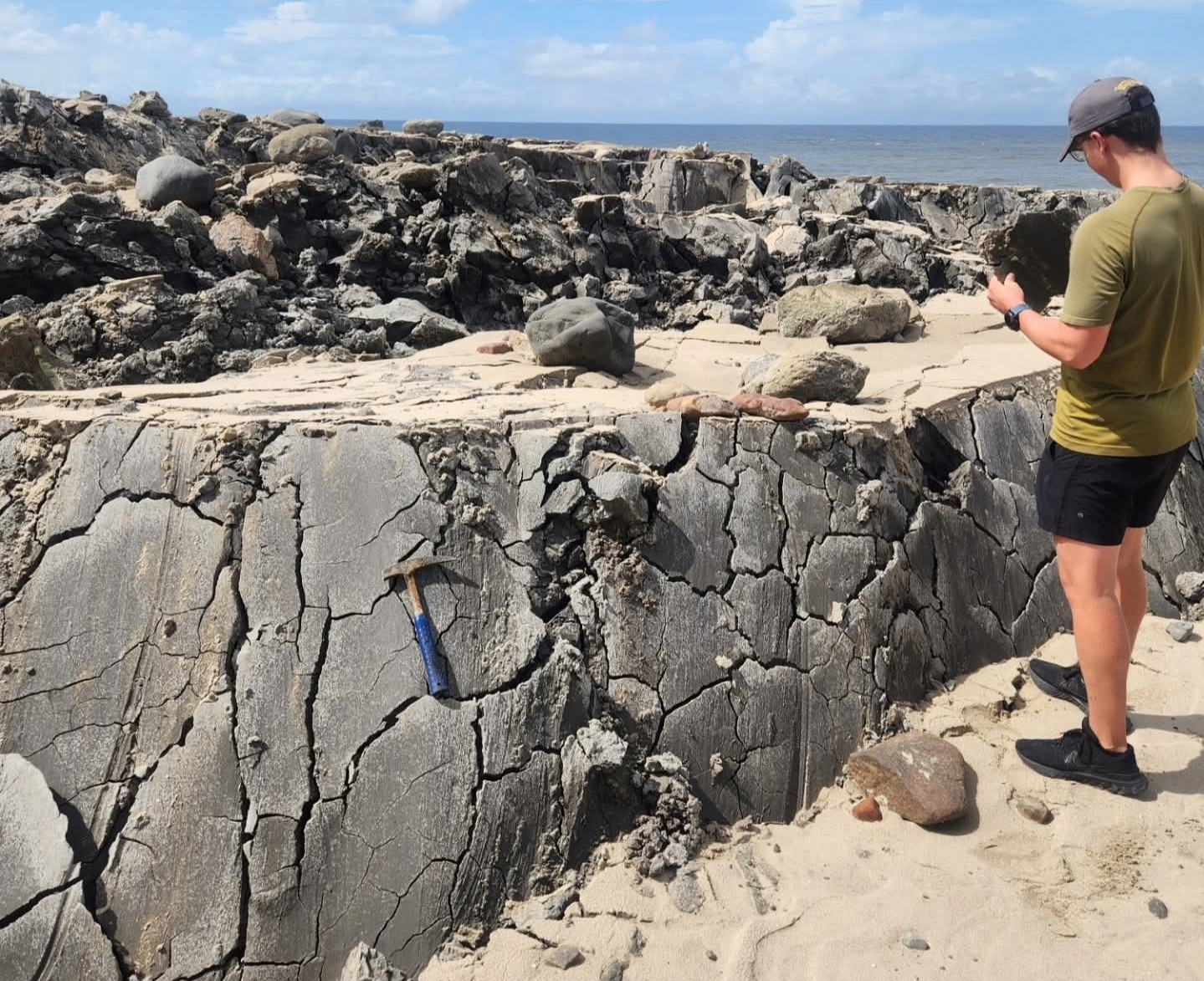
Earlier today, a team of geologists from Touchstone Exploration Inc. made an intriguing discovery at Galfa Point, a well-known geological site along the South West Peninsula. Galfa Point, recognized for its mud volcanoes and the Steeldrum-operated Bonasse oilfield, witnessed an unexpected change in its topography. A usually flat section of the beach was dramatically uplifted by as much as 20ft, causing the coastline to shift southwards by a staggering 100ft.
This uplift, which appears to have occurred almost instantly, has a distinct step-like appearance referred to as ‘toe thrusts’. A ripple effect of this swift change was evident in the numerous marine creatures that were left trapped and exposed to air, indicating the rapid pace of the event. Tragic evidence of this was a stingray, seemingly crushed by an uplifted boulder.
The upheaval also resulted in numerous faults and fractures, with the most significant offsets showing purely dip slip extensional motion. It’s believed that the beach’s uplift was triggered by a slumping or land slippage along the coastal cliffs, assisted by mobile shales from the adjacent mud volcanoes.
Interestingly, a tear fault at Galfa Point may have subtly moved due to seismic activity in Venezuela, further destabilizing the cliff section and triggering the slump. This activity reactivated a former oil seep, which is now causing multiple bubbling pools with slicks of oil.
While the area can only feasibly be restabilized naturally, it remains safe for visitors. However, caution should be exercised due to the presence of dead marine life and displaced boulders. Despite the tumult, pyrite, also known as fool’s gold, can still be found in abundance, a testament to the enduring geological wealth of the area.