

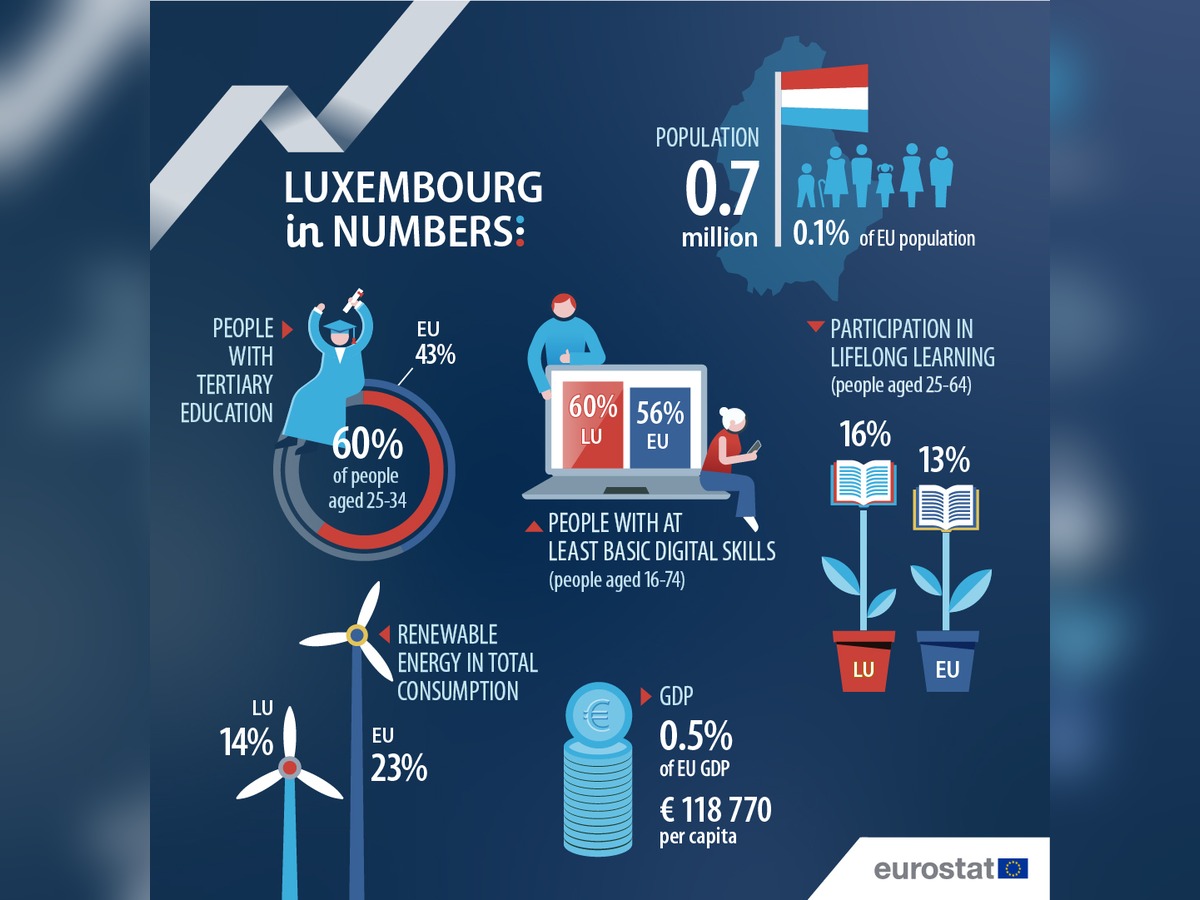
Luxembourg could approach or exceed one million inhabitants by 2070, according to population projections published by STATEC. But the range of outcomes turns on an economic question: how attractive will the country’s incomes remain compared with those of its neighbours? The statistics agency presents four scenarios linking productivity, economic attractiveness and migration. Against a population of approximately 691,000 on 31 December 2025, its lowest-growth scenario projects 944,000 inhabitants in 2070. The other scenarios produce populations of 966,000, 1,022,000 and 1,067,000 respectively. These are conditional projections rather than a single prediction. Higher productivity assumptions underpin the scenarios with larger populations. In STATEC’s model, productivity gains influence Luxembourg’s relative income attractiveness, which in turn influences net migration. The connection makes the country’s demographic future partly dependent on its economic performance relative to neighbouring countries. Migration is central to that calculation. According to STATEC, it has accounted for around 80% of Luxembourg’s population increase over recent decades and is expected to remain the main driver of growth over the projection period. Eurostat reaches a broadly similar population total to STATEC’s lower-growth scenarios, projecting 962,500 inhabitants in 2070. However, the two institutions use different approaches to migration. Eurostat extrapolates historical flows, using the average observed over the previous ten years and adjusting towards a long-term value common to EU countries. STATEC instead incorporates migration into its economic and demographic model. That methodological difference becomes particularly significant after the middle of the century. All the projections indicate population growth until then. From the mid-2050s, Eurostat anticipates near-stagnation, while STATEC’s higher-productivity scenarios show continued growth beyond one million inhabitants by 2070. The figures provide a framework for considering Luxembourg’s long-term development, but they do not establish that population growth will prevent ageing or guarantee financial security. Population totals alone cannot show how many people will be working, drawing pensions or requiring care. Those questions require age profiles and fiscal, employment and care data. The supported conclusion is narrower: Luxembourg’s future population is closely linked to the economic assumptions used to project migration. Whether the country reaches one million inhabitants matters, but understanding the conditions behind that number matters just as much.