
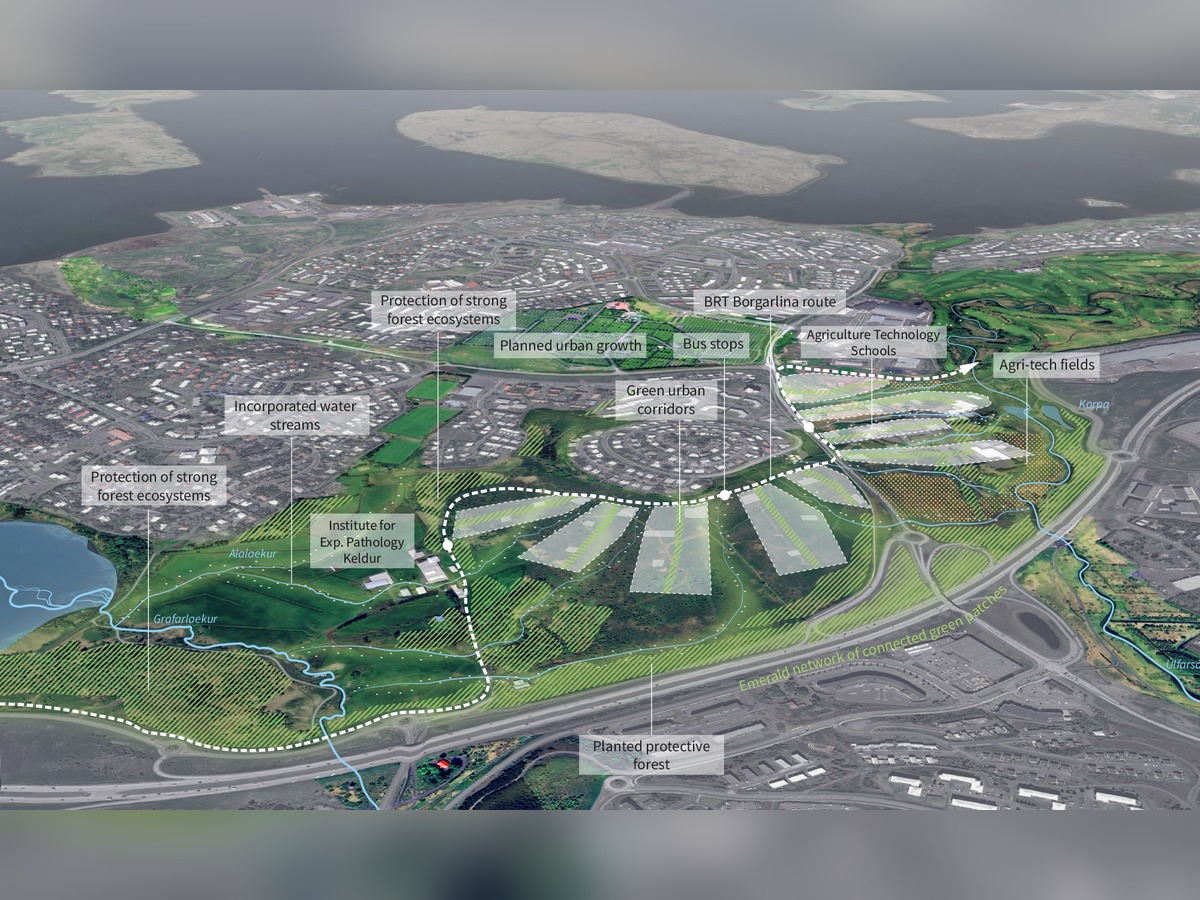
A design competition announced for Reykjavík’s Keldur area in January 2023 offered a concrete answer to a familiar planning question: should a new neighbourhood make cars essential, or give residents practical alternatives from the outset?
According to Streetsblog USA’s February 2023 report, officials sought proposals for a dense, mixed and carbon-neutral urban quarter on approximately 288 acres of undeveloped land. The site was described as roughly a 30-minute bicycle ride from the city’s central downtown. Sustainable transport was part of the competition’s brief, placing movement alongside the design of the neighbourhood itself.
One of the proposal’s most consequential commitments concerned money. Streetsblog reported that all profits from developing and selling the land were promised towards frequent bus rapid transit service for residents. That linked the development’s financial proceeds to an alternative to driving, rather than treating public transport as a separate aspiration.
The organisers also asked entrants to give priority to environmentally friendly, compact and convenient modes of transport. Together, those requirements suggested that the neighbourhood’s success would be judged partly by how people could reach and move through it without depending on automobiles.
The competition’s structure opened another question: who gets to propose the shape of a new urban district? Streetsblog reported that anyone could enter and that submissions would be judged anonymously by local officials and international advisers. Finalists advancing to the second round were to receive €50,000 each, with another €50,000 awarded to the eventual winner.
Brent Toderian, a planning adviser to Reykjavík and a competition juror, described the ambition as creating an urban place with multiple transport options. He also characterised the competition as a way to generate ideas, allowing flexibility rather than fixing every detail of a future master plan.
These were ambitions reported in 2023, not evidence of a completed neighbourhood. The account supplies no measurements of subsequent street safety, public transport performance, business activity or residents’ travel habits. It therefore cannot establish whether Keldur delivered on its promise, or whether Icelandic cities as a whole favour people or cars.
What it does document is a deliberate planning choice: a new district was being asked to accommodate alternatives to car dependence, with a stated funding connection to public transport. Whether that vision translated into everyday convenience remains the practical test.