
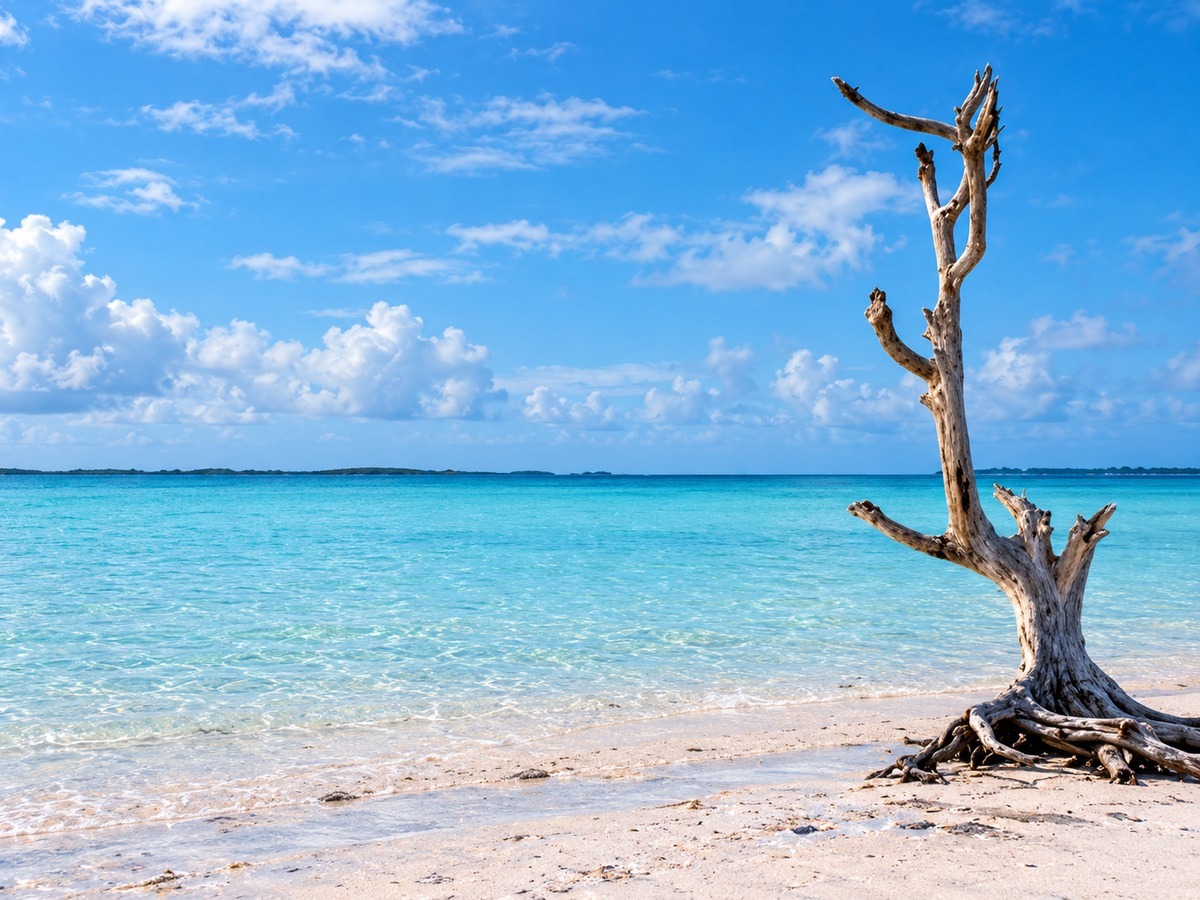
On the western side of Harbour Island, a weathered piece of driftwood became one of the island’s most unusual landmarks after appearing in the aftermath of Hurricane Andrew in 1992. Known simply as the Lone Tree, the enormous trunk stood upright on the sand at Girls Bank near Bay Street, creating a scene that looked less like storm debris and more like a natural sculpture deliberately placed beside the sea.
The Bahamas Ministry of Tourism describes the Lone Tree as a large piece of driftwood whose exact identity and journey remain uncertain. Local explanations have varied over the years. Some people have suggested it was once an almond tree, while others have identified it as a type of pine. What is more widely agreed is that the tree reached Girls Bank around the time Hurricane Andrew swept through The Bahamas in 1992.
The mystery is not simply what kind of tree it was, but how such a large trunk came to rest upright. One explanation holds that it moved down from a nearby hill during the storm. Another suggests powerful winds or water carried it from somewhere else, possibly even another island. The official tourism account does not attempt to settle the question, preserving the uncertainty that helped turn the Lone Tree into part of Harbour Island folklore.
Its position made the sight even stranger. Instead of lying flat like ordinary storm debris, the tree appeared anchored vertically in the shallow coastal landscape. The Ministry of Tourism has also noted that high tides could shift the tree slightly, meaning the landmark was not completely fixed despite its seemingly permanent presence. That combination of movement, mystery and striking appearance helped make it a favourite subject for photographers.
Over time, the Lone Tree became closely associated with Harbour Island’s visual identity. Wedding photographers, magazine crews and visitors repeatedly used the bare branches, exposed roots, pale sand and surrounding Bahamian water as a backdrop. The attraction required no monument, plaque or elaborate structure. Its appeal came from the fact that an ordinary piece of storm-tossed wood had been transformed by circumstance into something recognisable.
The story also reflects how hurricanes leave more than damage behind. Across the Caribbean and The Bahamas, powerful storms can reshape beaches, shift sandbanks, move trees and alter familiar coastlines within hours. In the case of the Lone Tree, one such event produced a feature that residents and visitors continued discussing long after Hurricane Andrew itself had passed.
That uncertainty remains central to the story. There is no universally accepted account explaining exactly where the tree originated or how it reached its upright position at Girls Bank. Instead, the competing explanations became part of the attraction. Harbour Island’s Lone Tree endured in local memory not because every detail was known, but because a storm in 1992 left behind an object so unusual that people kept asking how it got there.