

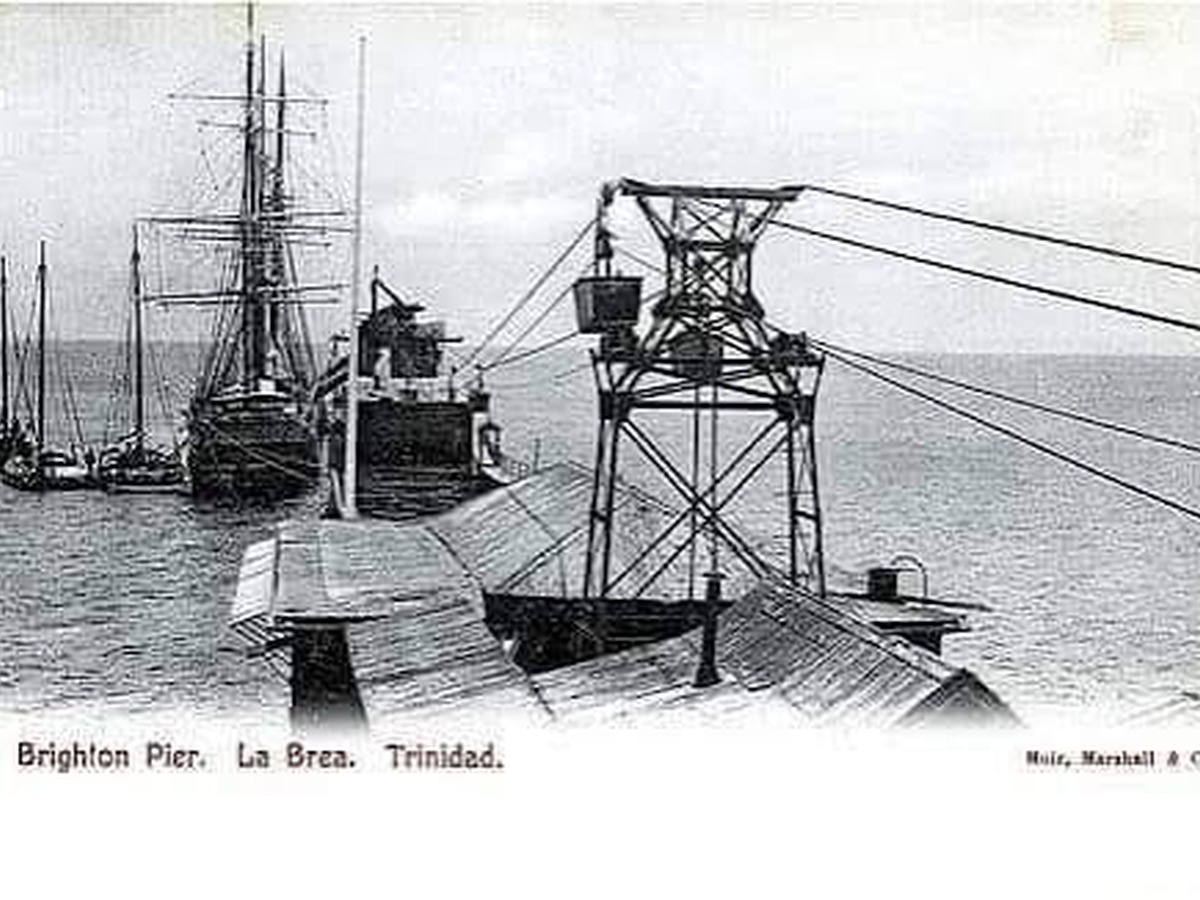
Long before modern conveyor systems became a familiar feature of heavy industry, asphalt from Trinidad’s famous Pitch Lake travelled above the landscape in large suspended buckets on its way to ships at Brighton, La Brea. A remarkable surviving description appears in The Wonderland of Trinidad, a promotional booklet issued by the Barber Asphalt Company and preserved digitally by Project Gutenberg. Its 1927 eleventh edition describes Brighton as an industrial community beside the Pitch Lake, where an overhead cable continuously carried large buckets filled with asphalt toward the coast. Workers first extracted asphalt from the lake and loaded it into small railway cars running on a narrow-gauge track. According to the booklet, the loaded cars were moved toward the refinery or pier, where buckets could be lifted from the trucks and attached to a moving conveyor cable. The system was designed so that the weight of loaded buckets travelling downhill helped pull empty buckets back in the opposite direction, reducing the amount of power required. At Brighton Pier, the operation became even more dramatic. Ships waited offshore at the end of a long pier while workers stood on an elevated platform above the water. As each loaded bucket arrived, its mechanism was released, tipping the asphalt through an opening and down a chute directly into the ship’s hold. Historical photographs reproduced in the same booklet show the narrow boardwalk, suspended buckets and workers operating the mechanism. Other images document labourers digging asphalt from the lake, loading small rail cars and working around the refinery, providing a rare visual record of an industrial system that once linked the Pitch Lake directly with international shipping. The document also describes the Pitch Lake itself as a vast, slowly moving mass of asphalt. Excavated areas gradually levelled again as surrounding material shifted, while rainwater collected in folds across its surface. The publication recorded a network of tracks, refinery equipment, workers’ quarters and loading facilities around La Brea, revealing how extensively the natural deposit shaped the surrounding community. Today, the surviving photographs offer more than a glimpse of an unusual machine. They preserve a period when Trinidad’s natural asphalt industry combined manual digging, narrow-gauge railways, aerial cables and marine transport in one continuous chain from the Pitch Lake to ships waiting in the Gulf of Paria.