

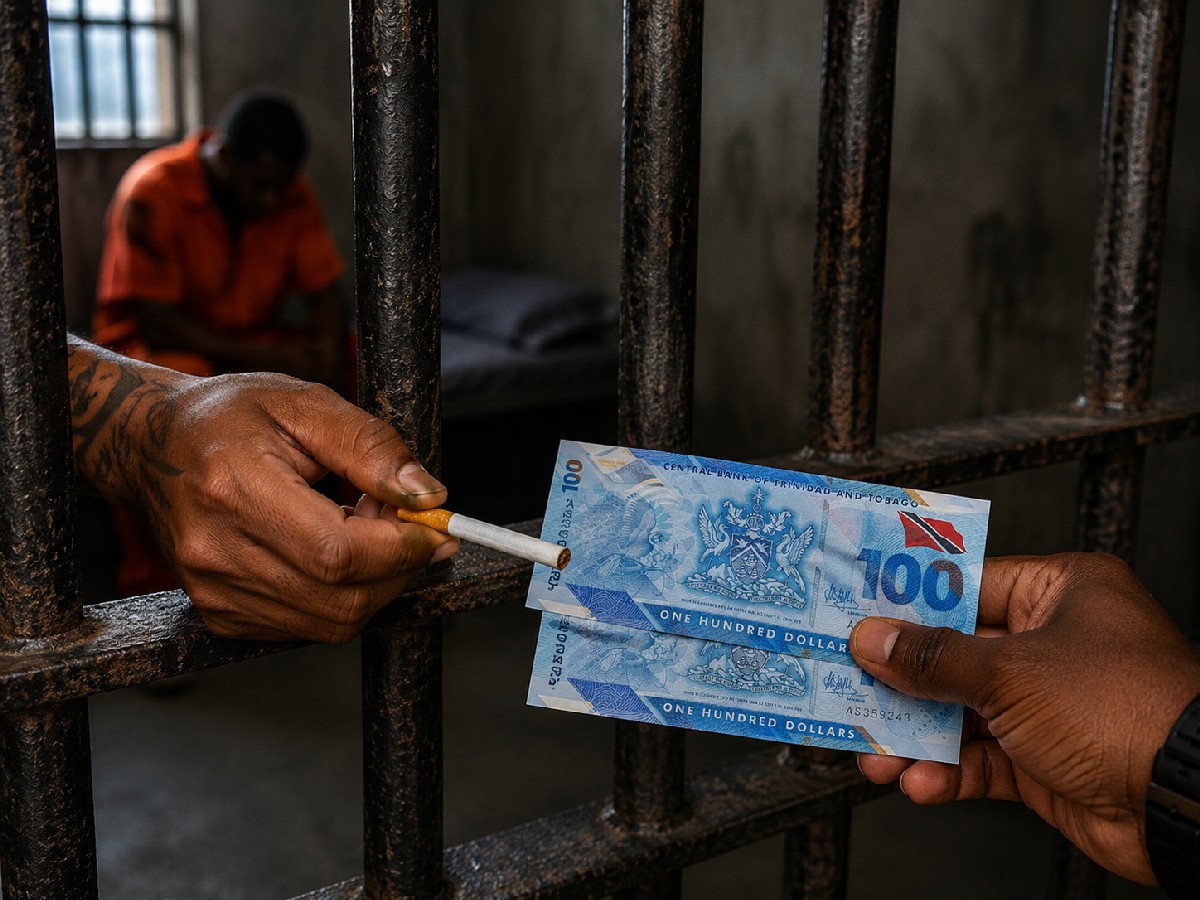
Behind Bars: The Underground Economy Where One Cigarette Can Cost $200
In Trinidad and Tobago’s prisons, an ordinary cigarette can become a luxury item.
Outside the prison walls, cigarettes, snacks, cellphone accessories and other everyday products have relatively predictable prices. Behind bars, however, scarcity, prohibition and demand can transform some of those same items into commodities worth several times their normal value.
Over the years, prison officials, former inmates and investigators have described an underground economy operating within the country’s correctional facilities, where cigarettes, cellphones, marijuana and even ordinary grocery items can be traded or used as a form of currency.
And recent seizures suggest the contraband market remains very much alive.
On August 28, 2026, the Trinidad and Tobago Prison Service reported that officers searching the Maximum Security Prison seized 14 cellphones, more than two kilograms of plant-like material resembling marijuana, improvised weapons and 285 packs of cigarettes.
Just days earlier, on August 23, officers at the Port of Spain Prison intercepted a package thrown over the perimeter wall containing 10 packs of L&M cigarettes, 20 packs of Du Maurier cigarettes, a cellphone, wireless headset, charging cable and plant-like material resembling marijuana.
The quantities involved raise an obvious question: what are these items worth once they get behind prison walls?
The answer can be startling.
Former Prisons Commissioner Dennis Pulchan told a parliamentary Joint Select Committee in March 2021 that a pack of cigarettes which cost about $25 outside prison could be illegally sold inside for around $500.
That represented a markup of roughly 20 times the ordinary retail price at the time.
Other accounts suggest prices can rise even higher depending on supply.
Former acting Prisons Commissioner Deopersad Ramoutar said in 2022 that a single cigarette could command between $100 and $200 inside prison. He explained that prices fluctuate according to availability: when security operations reduce supplies, prices rise; when more contraband becomes available, they fall.
At $100 per cigarette, 20 individual cigarettes could theoretically generate $2,000 if resold separately. At $200 each, the same number could represent $4,000 in prison-market value, although that does not mean an intact pack would necessarily be sold for that amount.
Former inmate Emmanuel Clarke gave Newsday another glimpse into the system in 2020. He claimed relatives could send as much as $1,000 to enable an inmate to obtain a pack of Du Maurier cigarettes, with individual cigarettes subsequently resold for the equivalent of around $100 each.
Another former inmate interviewed in 2023 similarly described cigarettes reaching as much as $200 each during periods of scarcity.
This economy is not based entirely on physical cash.
Former prison officials have described a barter system in which groceries and other items purchased by relatives can become currency. Phone credit, transfers facilitated by people outside prison and exchanges between inmates have also been reported as ways of settling transactions.
Cigarettes are only one part of the market.
Former Prisons Commissioner Gerard Wilson said in 2025 that prisoners could pay as much as $3,000 for a basic cellphone. He also described a gram of marijuana selling for around $50, while certain higher-grade quantities could command between $800 and $1,000.
Authorities have long regarded illegal cellphones as particularly dangerous because their value goes far beyond entertainment or communication with relatives. Officials have warned that phones can potentially allow incarcerated criminals to maintain contact with networks outside the prisons and facilitate criminal activity.
The scale of the contraband economy was illustrated during a major enforcement drive in 2022.
Authorities reported seizing 223 cellphones, 9,159 cigarettes and more than 14 kilograms of marijuana during hundreds of searches. The estimated value assigned to the cigarettes alone was more than $915,000.
Officers also recovered hundreds of cellphone chargers, batteries, SIM cards, improvised weapons, razor blades, lighters, wrapping paper, headsets and other prohibited articles.
Prison authorities have repeatedly said contraband enters facilities through several methods. Items have been thrown over perimeter walls, concealed on people entering facilities and, in previous cases, allegedly trafficked by corrupt officers. Drones have also been used in attempts to deliver prohibited items.
The economics help explain why the trade is so persistent.
Something inexpensive outside prison can become extraordinarily valuable once access is restricted. A person capable of moving cigarettes, a cellphone or another sought-after commodity across the prison boundary is therefore not simply delivering an item; they are introducing something into a closed market where scarcity can multiply its value.
That creates incentives for trafficking while placing enormous pressure on prison security.
The August 2026 seizures demonstrate that despite years of searches, arrests and tightened controls, the battle against prison contraband continues.
Behind those walls, a cigarette is no longer simply a cigarette.
Depending on supply and demand, documented accounts suggest one cigarette has commanded anywhere from tens of dollars to as much as $200, while packs have previously been reported at $500 or even around $1,000.
It is a shadow economy created by scarcity, sustained by demand and lucrative enough that authorities continue to intercept hundreds of packs at a time.
And every major seizure potentially does something else: it makes whatever remains inside even more valuable.