

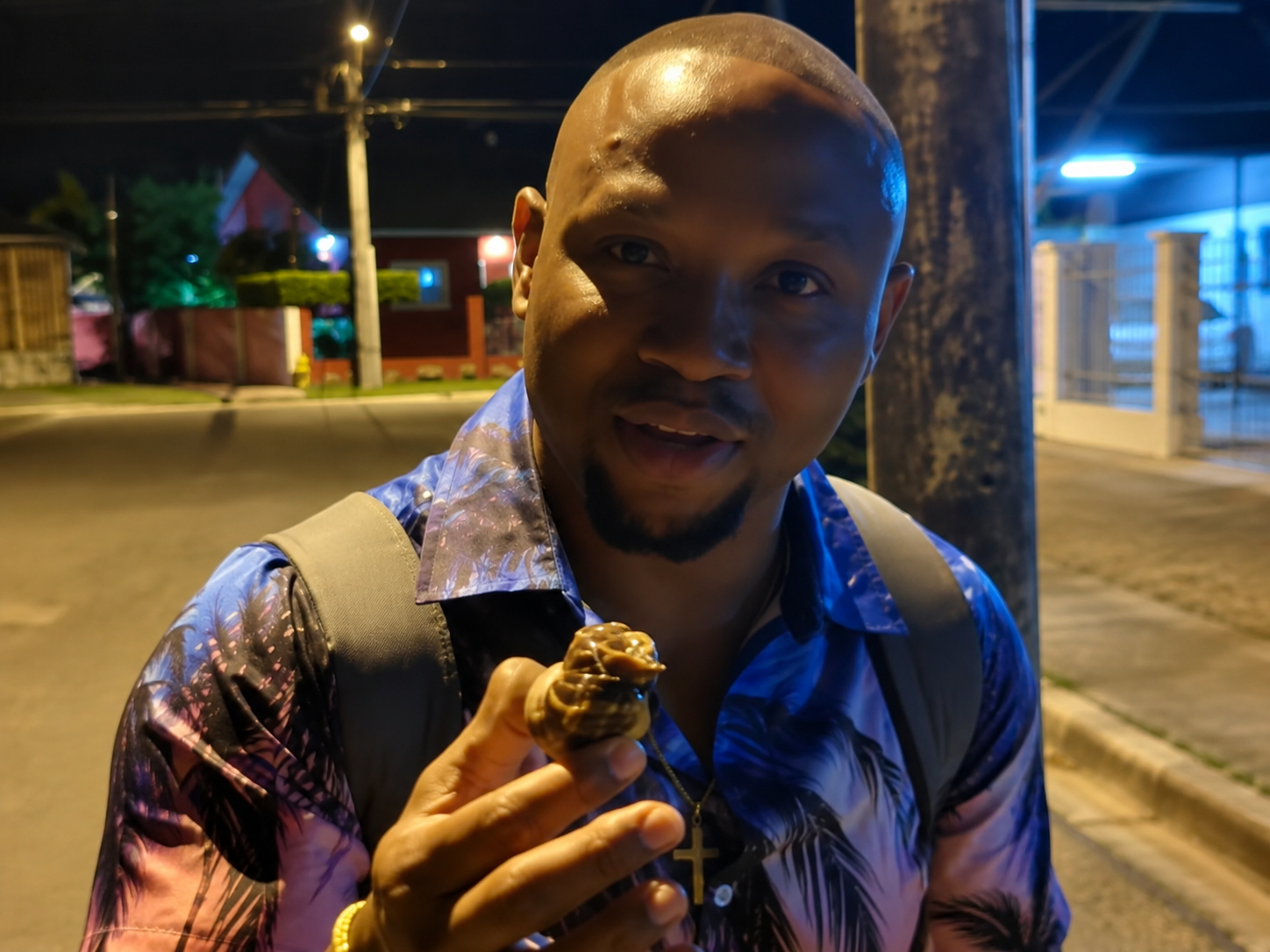
A Nigerian man living in Trinidad and Tobago has sparked an interesting cultural conversation after picking up a giant African snail and announcing that he intends to take it home and cook it while keeping one important detail from his wife.
“I’m going to cook this one. I won’t let my wife know that I’m cooking it,” he says in the video.
Looking at an animal Trinidad and Tobago has spent years trying to control, the man sees something completely different: meat.
“Plenty of giant African snails in Trinidad, crawling all over, for free. God has given you guys meat for free, and you guys don’t want to eat it,” he says.
His bewilderment makes more sense when the cultural context is considered.
Large land snails are eaten in parts of West and Central Africa. The UN Food and Agriculture Organization notes that edible giant snails are common across parts of sub-Saharan Africa, including southern Nigeria, where Archachatina marginata occurs. In parts of the southern forest region, snails are regarded as a delicacy and are collected, sold fresh or smoke-dried and eaten as food. Attitudes vary considerably, however, and some communities traditionally avoid them altogether.
There is also real nutritional value behind the man’s description of the snail as “meat.” FAO nutritional data list dried meat meal from Achatina fulica at about 45.6% crude protein, while snail meal without the shell reaches about 60.9% protein on a dry-matter basis. Those figures should not be confused with the protein percentage of a fresh snail, which contains substantial water, but they demonstrate that snail flesh can be a protein-rich food.
That creates an amusing clash of perspectives.
To Trinidad’s agricultural authorities, the giant African snail (Lissachatina fulica) is one of the world’s most destructive invasive land snails. It was first discovered in Trinidad in 2008 and has since spread into several areas. The Ministry of Agriculture says the species can attack more than 500 types of plants, including vegetables, fruit trees, cassava, dasheen, cocoa and ornamentals.
It is also an extraordinary breeder. According to the Ministry, a giant African snail can lay as many as 400 eggs at a time, produce three clutches in a year and live for up to nine years.
So while Trinidadians may see a creature capable of multiplying rapidly and destroying a kitchen garden, this Nigerian resident apparently sees protein crawling past his doorstep.
And Trinidadians should probably understand that cultural difference better than most.
The green iguana, for example, has long been eaten in Trinidad and Tobago and forms part of local wild-meat traditions. Yet travel to Florida and the same animal occupies a very different position. Green iguanas are invasive there, and the Florida Fish and Wildlife Conservation Commission encourages their removal. They may be humanely killed on private property with the landowner’s permission, and Florida has introduced extensive measures to control their population.
In other words, a Trinidadian might look at an iguana and think about a pot, while someone elsewhere sees an invasive reptile tearing up their property.
This Nigerian man’s reaction to Trinidad’s snails is essentially the reverse.
There is, however, an important health distinction between recognising snails as food and simply collecting an invasive snail from the roadside and eating it.
Trinidad and Tobago’s Ministry of Agriculture warns that giant African snails can carry the rat lungworm (Angiostrongylus cantonensis), a parasite capable of causing serious illness, including eosinophilic meningitis in humans. Handling and consumption therefore carry risks and should not be treated casually.
So his claim that Trinidad has been blessed with “meat for free” may not be the pest-control strategy authorities are looking for.
But the video does offer a funny reminder of how dramatically perceptions of the same animal can change across cultures.
Trinidad sees an invasive snail it wants gone.
He sees dinner.
His wife, apparently, isn’t supposed to know.
Article and image source: facebook.com