

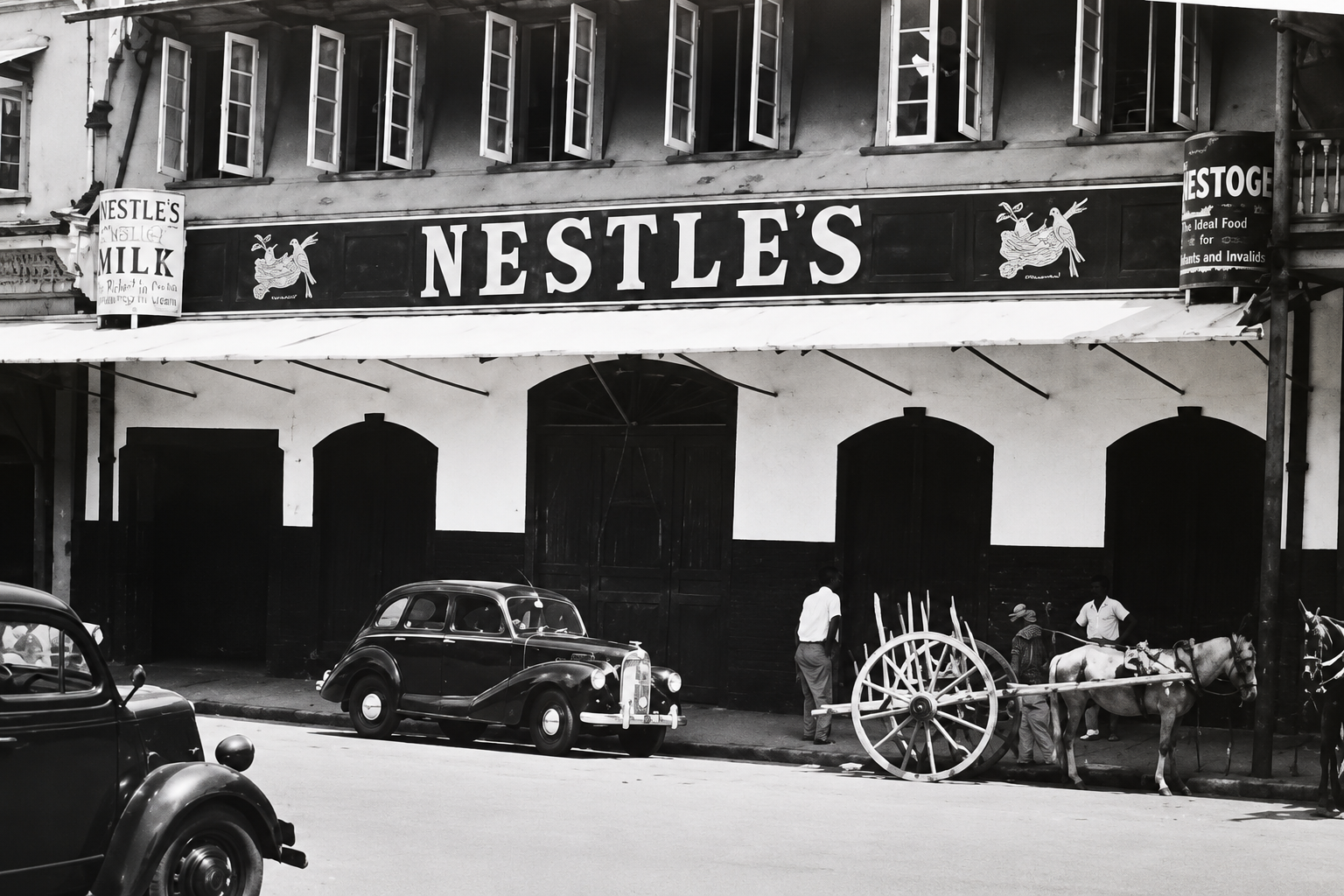
Nestlé’s 110-Year Legacy in Trinidad Faces Uncertain Future
For more than a century, Nestlé has been part of everyday life in Trinidad and Tobago, with generations growing up on products such as Milo, Carnation, Maggi, Orchard and Choc Nut. Now, after 110 years of operations, the company’s local dairy and juice business is under strategic review, raising questions about the future of one of the country’s longest-standing manufacturers.
Nestlé’s history in Trinidad and Tobago dates back to 1914, when Nestlé and the Anglo-Swiss Condensed Milk Company established a trading agency at Marine Square in Port of Spain, now known as Independence Square. At the time, the company introduced products such as sweetened condensed milk and chocolates, laying the foundation for a relationship with Trinidad and Tobago that has endured for generations.
Although many Trinidadians often associate Maggi with local culture, the brand actually originated in Switzerland during the late 19th century before becoming part of the Nestlé family. Over the decades, however, it became so deeply embedded in local cooking that many regard it as a Trinidadian staple.
A major milestone came in 1962, when the country’s first Prime Minister, Dr Eric Williams, officially commissioned Nestlé’s manufacturing facility at Valsayn. The factory became a cornerstone of local food production, purchasing milk from hundreds of dairy farmers while producing household brands that became synonymous with family life across the nation.
Products including Orchard, Milo, Carnation, Choc Nut, and Green Butterfly were manufactured locally, providing employment while supporting the country’s agricultural sector through consistent milk collection.
Nestlé further strengthened its investment in Trinidad and Tobago in 2018, restructuring its Caribbean operations and transforming the Valsayn plant into what the company described as the most digitally connected ready-to-drink manufacturing facility within the global Nestlé network.
Today, the company collects approximately 3,500 kilograms of fresh milk each day from more than 75 contracted dairy farmers, representing an estimated 86 per cent of Trinidad and Tobago’s local milk production. Nestlé has also invested in the dairy industry through initiatives such as its model “Cow Spa” farm in Tabaquite, which promotes regenerative farming techniques and improved animal welfare.
However, Nestlé has confirmed that its dairy and juice operations in Trinidad and Tobago are currently undergoing a strategic review, with a possible sale being considered. While the company has indicated its intention to preserve local jobs and maintain the heritage of its well-known brands, the outcome of the review remains uncertain.
Any significant changes could have implications not only for employees but also for local dairy farmers whose livelihoods depend on supplying milk to the company, as well as consumers who have grown up with products manufactured locally.
From a modest trading office in Port of Spain in 1914 to a modern manufacturing operation serving the Caribbean, Nestlé’s story has become intertwined with Trinidad and Tobago’s own industrial development. Whether through a cup of Milo, Carnation milk in tea, Maggi cubes in a pot of soup, or Orchard juice at family gatherings, the company’s brands have become woven into the fabric of everyday life.
As discussions over the future of the dairy and juice business continue, many will be watching closely to see what the next chapter holds for one of Trinidad and Tobago’s oldest and most recognizable manufacturers.